

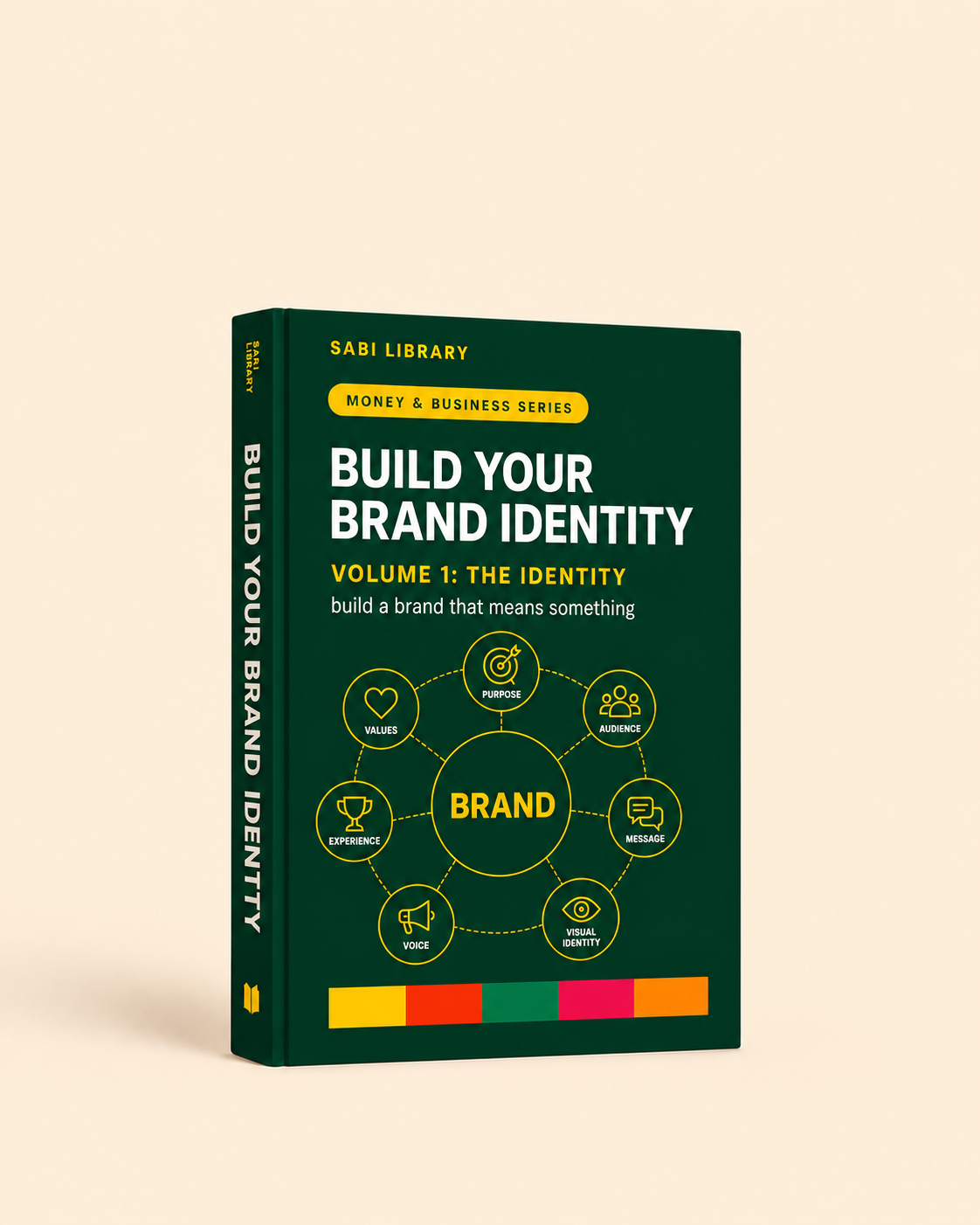
If You No Sabi Branding, We Sabi.
Nobody teaches founders how to build a brand people actually remember.So we learn by watching competitors with a worse product win anyway.
Nobody Builds This On Purpose
At first it looks like a marketing problem. Sales are fine, growth is fine, so branding gets filed under "someday."
Then a customer describes you using a competitor's name. Then a freelancer designs something that does not look like anything you have made before. Then the only thing left to compete on, in every single sales conversation, is price.
By the time it is undeniable, you have already spent a year and your margin training customers to choose you for the wrong reason.
You do not need another moodboard or a nicer logo. You need the actual decision architecture, purpose, positioning, voice, and visual system, that makes a brand impossible to confuse with anyone else.
Every founder remembers the year they realized their brand was not actually a brand. This volume exists so that year does not have to be this one.
Most Founders Are Never Taught This
The actual difference between a logo and a brand.
Why some companies charge triple for a similar product.
How to tell if you have a positioning problem or a marketing problem.
How to keep a brand consistent once you are not the only one making decisions.
Your Problem vs The Solution
We have listed 4 problems. Pick yours to know the solution.
- A customer compares your price to a competitor's.
- It happens on every single call now, not just occasionally.
- You are no longer selling a product, you are defending a number.
Brand Positioning
"A position is only real if it is specific enough to be wrong, and threatening enough that a competitor has to respond to it."
- You stop being the "also available" option next to a cheaper competitor.
- Customers can explain why they chose you, in their own words.
- Price stops being the first thing anyone asks about.
- A customer mentions a rival's name while describing your business.
- You realize it has happened more than once.
- Whatever makes you different has never actually been visible from the outside.
Brand Differentiation
"Positioning is a claim. Differentiation is proof of that claim across seven layers, and most brands can only defend one or two."
- You find the layer, design, community, pricing, that is actually defensible.
- Competitors can no longer copy you by matching one feature.
- Being mistaken for someone else stops happening.
- You ask five customers what your business does.
- You get five different answers, none quite right.
- If they cannot repeat it, they cannot refer it, and every referral that never happened is revenue you never saw.
Messaging Framework
"A messaging house turns one core belief into a structure the whole company can speak from."
- One sentence, the same one, every time someone asks what you do.
- Referrals get easier because the pitch does the work for them.
- Your team stops improvising a new explanation every time.
- Your Instagram does not match your invoice.
- Your invoice does not match your website.
- A new hire looks at all three and genuinely cannot tell they belong to the same company.
Brand Consistency
"Recognition is cumulative, not one time. Every inconsistent touchpoint resets a small part of the progress the consistent ones built."
- A documented system a freelancer can follow without a meeting.
- Recognition that compounds instead of resetting every quarter.
- One brand, everywhere it shows up.
A Sample of the Frameworks
Each chapter pairs a framework with a real, named case study.
The Positioning Statement Formula
A claim specific enough to be wrong is the only kind actually worth making.
The 7 Layers of Differentiation
Functional, emotional, experiential, community, design, pricing, category. Most brands can only defend one or two.
The Brand Asset Inventory
Recognition today lives beyond the logo, and most brands are sitting on assets they have never formalized.
Complete Your Operating System
Build Your Brand Strategy
- Unit economics and pricing that actually protects margin
- A growth engine built on loops, not luck
- CRM and retention systems that make revenue predictable
Build Your Brand System
- The founder dashboard that catches problems early
- Meeting, launch, and quality checklists your team can run without you
- The closing chapters on brand loyalty and the long game